
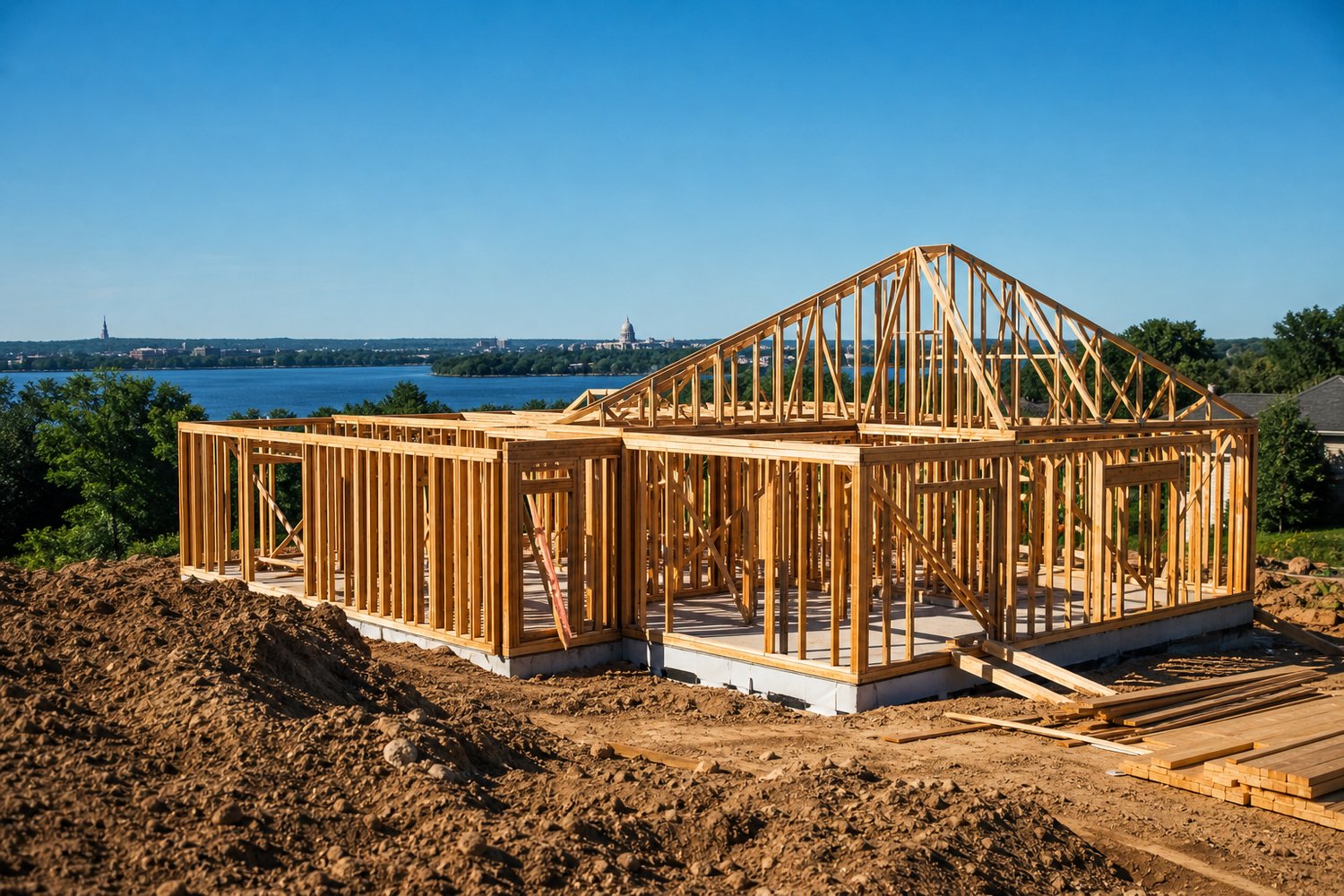
Before you offer on a Madison home, look up the zoning of the parcels around it, not just the lot itself. The city’s draft data-center framework would cap size at 100,000 square feet, bar campuses, and map buffers near homes, but it remains a proposal until the Common Council adopts final language.
What do Madison’s Data-Center Rules mean for homebuyers?
Madison’s Data-Center Rules are still a draft. The city paused new data-center zoning approvals over 10,000 square feet in January 2026, and its proposed framework would cap any facility at 100,000 square feet, keep large ones in industrial areas away from homes, and bar multi-building campuses. Buyers should check the parcels around a home, not rely on a neighborhood name.
Key Takeaways
- Madison homes sold at a median of $439,791 (all home types sold July–September 2026), which is a big enough purchase to justify an hour of land-use research before you offer.
- The 100,000-square-foot cap, the residential buffers, and the campus ban are proposed, not final, until the Common Council adopts an ordinance.
- The January 13, 2026 moratorium is the only piece in effect: it pauses zoning approvals for new data centers over 10,000 square feet when the data center is the primary use.
- Madison’s rules apply only inside the City of Madison, so homes in Fitchburg, Middleton, Monona, Sun Prairie, and other nearby communities fall under their own zoning authorities.
- The right screening unit is the parcel and the land around it (zoning, adopted plans, pending applications), not a neighborhood label.
I’m Keith McNeely, a Madison, WI REALTOR® with First Weber. I’ve spent years looking at what sits next to a property, first as an investor rehabbing and managing my own single- and multi-family buildings, and now with buyers across Dane County. Data centers are a new item on that checklist. Here is what the city has actually put on paper, and how I’d evaluate a specific address.
What is in Madison’s Data-Center Rules so far?
Right now, only a temporary moratorium is in effect. The rest is a proposed framework the city developed while the moratorium runs, and it can change before the Common Council votes.
| Stage | What it does | Status |
|---|---|---|
| Temporary moratorium (approved January 13, 2026) | Pauses zoning approvals for new data centers over 10,000 square feet when the data center is the primary use | In effect, for up to one year |
| Draft regulation framework (October 2026) | Size tiers, a 100,000-square-foot maximum, industrial-only siting for large facilities, a mapped buffer, and no campuses | Proposed |
| Final ordinance | Whatever language the Common Council adopts | Verify with the city before relying on any detail |
What does the moratorium do today?
It pauses zoning approvals for new primary-use data centers larger than 10,000 square feet, and it can last up to one year while the city writes permanent regulations, according to the City of Madison’s moratorium page. It does not freeze every warehouse, utility, or industrial project. It targets one use at one size.
What would the draft framework add?
The proposal would prohibit data centers larger than 100,000 square feet anywhere in Madison. That is a proposed maximum, not an enacted citywide rule. The city’s materials also sort data centers into three size categories:
- Less than 10,000 square feet
- 10,000–50,000 square feet
- 50,000–100,000 square feet, which the city calls “large”
Large data centers would be limited to industrial areas and subject to a mapped buffer. The proposed data center map would restrict locations near existing residential areas, land planned for future residential use, parks, and open space, per the same city page.
Would Madison allow data-center campuses?
No. Under the draft, a data center would have to occupy a single building, and only one data-center building would be allowed on a property, according to the city’s announcement of the draft framework public meeting. Several smaller buildings could not be combined on one lot.
How far would a data center have to be from a house?
Local reporting describes a proposed 300-foot separation from residential buildings for larger facilities, aimed at noise and related neighborhood impacts, in The Capital Times’ look at the questions Madison planners face. The same coverage describes a proposed 1,000-foot separation between certain medium and large facilities, meant to keep separate buildings from clustering into an effective campus. Treat both distances as proposed until final ordinance language exists.
The city scheduled a public information meeting on the draft for October 27, 2026. Its event page is where I’d look for follow-up. If you’re buying now, confirm where the draft stands before you rely on any buffer. For the broader picture of how zoning changes are hitting buyers and sellers, I covered it in What Madison’s Zoning Changes Mean for Buyers and Sellers.
How do you check land-use risk near a Madison home?
Start with the parcel, then widen out to the land around it. Check the zoning of the home’s lot, the zoning and adopted plan designation of nearby parcels, and whether anything is pending with the city. The neighborhood name tells you very little. The parcel records tell you what could be built.
A parcel-first checklist
- Pull the zoning for your subject parcel and every parcel that touches it or sits across the street.
- Look for vacant or underused land designated for industrial or employment use. A parcel that is empty today may still be planned for a very different use later.
- Check for planned residential areas, parks, and open space nearby. Under the proposed map, land planned for future homes could receive protection even before houses are built.
- Look up the proposed data center map once it is final and see whether the parcel falls inside a buffer.
- Search for pending applications. Zoning-approval applications, conditional-use or development-review materials, public meeting notices, and Common Council actions all show where a project stands. The city’s moratorium page is the starting point for the data-center items specifically.
Which physical features are screening indicators?
These are signals to investigate, not proof that anything is proposed:
- Industrial zoning next to or near the home
- Major electrical infrastructure, such as substations or transmission corridors
- Large undeveloped employment parcels
- Roads capable of serving industrial-scale construction traffic
If you see two or three of these together, that is when I’d slow down and read the zoning and plan documents line by line. Seeing one of them alone usually means nothing.
Why look at adjacent parcels, not only the lot?
Because the draft framework treats a single building on a single property as the allowed form. A 50,000–100,000-square-foot building on one parcel could still fall in the “large” category, while multiple smaller buildings on one lot would not be permitted as a campus. Separate parcels can raise a different land-use question than a campus on one lot would, so the review has to include the neighbors, not only the address you’re touring.
This is exactly the kind of homework I walk my clients through before they write an offer. Every parcel is different, and the answer for one street says nothing about the next.
Do Madison’s Data-Center Rules apply outside the city?
No. Madison’s Data-Center Rules apply only within the City of Madison. Fitchburg, Middleton, Monona, Sun Prairie, and the towns of Dane County each have their own zoning authorities, and they may not adopt the same size limits or buffers. If your search spans several communities, you need to check each one’s rules separately. I broke down similar jurisdiction differences in Selling in Madison vs. Middleton, What Changes.
How does this fit into today’s Madison market?
Recent local market data shows a quick market. For all home types sold July–September 2026 within Madison city limits:
- The median sale price was $439,791, up 4.7% from $420,000 in the same window a year earlier.
- 749 homes sold, compared with 715 a year earlier.
- Months of supply were 2.8, compared with 2.5 a year earlier.
- 31% of homes went under contract within two weeks of listing, and the median time from listing to pending was 9 days.
Those are area-level figures, and an individual home’s value depends on condition, street, build year, and timing. When homes go under contract that fast, you don’t have long to research the land around a property. Do the parcel review as soon as a home makes your shortlist, not after your offer is accepted. You can see how the pace is trending in my October 2026 Greater Madison housing market update.
Can market data tell you which neighborhoods carry land-use exposure?
No, and I don’t rank neighborhoods that way. Sale prices and days on market describe transaction conditions. They say nothing about future land use. A real assessment needs parcel-specific zoning, adopted plans, pending applications, and the final status of the city’s regulations. If a deal hinges on what could be built next door, I’d rather verify it with you than guess.
If you’re selling near industrial or employment land, expect buyers to ask the same questions. Knowing the zoning and plan designations around your property before you list lets you answer them with facts. Pricing strategy matters too, and I cover that in What Madison-Area Sellers Need to Know About Pricing Now.
Curious how past clients feel about working with me? Read my reviews on Google and Zillow.
FAQ
Is Madison banning all new data centers, or only the very large ones?
Madison is not proposing a ban on all data centers. The proposal would prohibit facilities larger than 100,000 square feet and would put large ones (50,000–100,000 square feet) in industrial areas with a mapped buffer. Separately, the temporary moratorium pauses zoning approvals for new primary-use data centers over 10,000 square feet.
What does the proposed 100,000-square-foot cap mean for nearby homeowners?
It sets a ceiling on the size of any single data-center building in the city. Combined with the proposed single-building rule and the mapped buffers, it would limit how big a facility could get and where large ones could go. It is still a proposal, so it is not a guarantee for any particular address.
Can a developer build several smaller data centers on one Madison property?
Not under the draft. A data center would have to occupy a single building, and only one data-center building would be allowed per property, so a multi-building campus on one lot would not be permitted. Always check adjacent parcels separately, since they carry their own zoning.
Does the current moratorium stop an already-approved data center project?
The city describes the moratorium as pausing zoning approvals for new primary-use data centers over 10,000 square feet. Whether it affects a specific project depends on where that project stands, so confirm the approval status in the city’s zoning and development-review records instead of assuming either way.
How can I check whether land near a Madison home could become a data-center site?
Look up the zoning and plan designation of the home’s parcel and the surrounding parcels, then search for pending applications, public meeting notices, and Common Council actions. Industrial or employment designations, large undeveloped parcels, and nearby electrical infrastructure are screening indicators, not proof. I can run this review with you before you offer.
Do Madison’s proposed rules apply in Fitchburg, Middleton, Sun Prairie, or other nearby communities?
No. Madison’s zoning applies only inside the City of Madison. Fitchburg, Middleton, Monona, Sun Prairie, and surrounding Dane County towns are governed by their own zoning authorities and may not have the same restrictions or buffers.
The takeaway: the framework is a proposal, the moratorium is temporary, and the only reliable way to judge land-use risk is parcel by parcel. If you’re weighing a specific Madison address, or comparing Madison with nearby communities, I’ll pull the zoning and plan records with you before you commit. Schedule a consultation and we’ll look at the parcels together.
Talk soon,
Keith
Equal Housing Opportunity. Keith McNeely is a Real Estate Salesperson with First Weber, licensed in Wisconsin and regulated by the Wisconsin Department of Safety and Professional Services (DSPS). This article is general information, not legal, tax, or financial advice; confirm your own numbers and zoning questions with your title company, tax advisor, lender, or the City of Madison.