
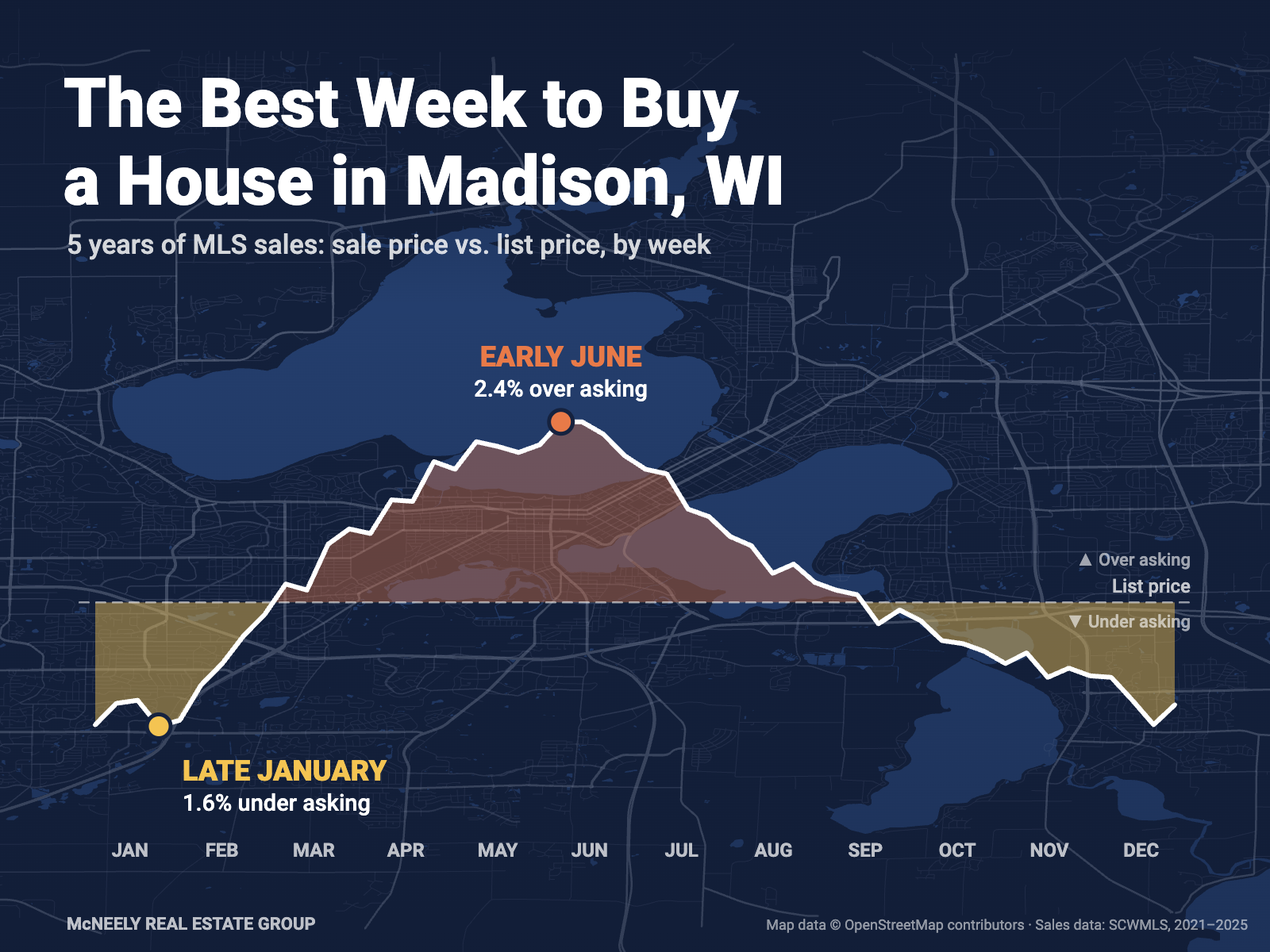
Based on five years of closed sales in the South Central Wisconsin MLS (2021–2025), the best week to buy a house in the Madison area is the last full week of January, roughly January 22–28. Homes closing that week sold for an average of 1.6% below asking price after a median of 26 days on market. Homes closing in early June sold for about 2.4% over asking after just 7 days.
When is the best time to buy a house in Madison, WI?
The best time to buy a house in Madison and South Central Wisconsin is winter, and the single best week is the last full week of January. I pulled every closed residential sale in the South Central Wisconsin MLS (SCWMLS) from 2021 through 2025 and averaged the results for each week of the year. Late January came out on top for negotiating room, for days on market, and for price per square foot. It also held up every year, not just on average.
The toughest time to buy is late spring into early summer. From May through mid-June, buyers routinely paid over asking price, and homes went under contract in about a week.
Key Takeaways
- Homes that closed in week 4 of the year (about January 22–28) sold for an average of 1.6% below list price, the widest discount of any week in the five-year data.
- Those same homes had a median of 26 days on market, compared to 7–8 days in May and June.
- After adjusting for year-over-year price growth, January price per square foot ran about 5% below trend, while May and June ran about 4% above.
- Week 4 ranked in the top six weeks for buyers in every year from 2021 to 2025, and it was the single best week in both 2024 and 2025.
- These are closing dates. To close in late January, you would typically tour homes and write offers from mid-December through early January.
What did five years of Madison-area sales data show?
I looked at two measures of buyer competition for every week of the year: how the final sale price compared to the list price, and the median number of days a home sat on the market. Then I compared price per square foot by month, adjusted for the steady price growth the market has seen since 2021, so an older January doesn’t look cheap just because it’s older.
The pattern is a clear seasonal cycle. Competition builds from March, peaks in May and June, cools through the fall, and bottoms out between the holidays and early February.
| Time of Year (Closing Date) | Avg. Sale Price vs. List | Median Days on Market | $/Sq Ft vs. Trend |
|---|---|---|---|
| Late Dec – early Feb | −1.5% | 22 | About 4–5% below |
| Mid-Feb – early Mar | −0.4% | 17 | About 2% below |
| Mid-Mar – April | +1.0% | 9 | At to 3% above |
| May – June | +2.1% | 8 | About 4% above |
| July – August | +0.9% | 9 | About 1–3% above |
| September – October | −0.3% | 13 | About 1% above to 1% below |
| November – mid-Dec | −1.0% | 16 | About 2–4% below |
Figures are five-year averages (2021–2025) of weekly closed-sale data from the South Central Wisconsin MLS, market-wide. Price per square foot is measured monthly and compared to the market’s overall growth trend. Some of the winter price-per-square-foot dip may reflect which homes sell in winter, not only discounts, so I lean most on the sale-to-list and days-on-market numbers.
Why is late January the best week to buy?
It comes down to fewer buyers competing for each home. Here is what I see in the data and on the ground:
Fewer buyers are shopping over the holidays
Homes that close in late January mostly went under contract from mid-December to early January. Most buyers pause their search during the holidays and cold weather, so the buyers who stay active face far less competition.
Sellers who list in winter are often motivated
A homeowner who keeps a home on the market through December usually has a reason to sell, such as a job move, a new home already purchased, or a timeline they need to meet. That shows up in the numbers: homes closing in late January averaged 1.6% below list price.
You have time to make a decision
A median of 26 days on market means you can usually schedule a second showing, get an inspection done without pressure, and negotiate repairs. In May and June, with a 7–8 day median, buyers often have to decide after one visit.
What are the trade-offs of buying in winter?
The biggest trade-off is selection. Far fewer homes sell in January than in June. In the five years of data, January closings ran roughly half of June’s volume. If you need a very specific home, school district, or neighborhood, you may see fewer choices in winter.
Winter also makes some things harder to check, like the roof under snow, the landscaping, drainage, and the air conditioning. A good inspector can work around most of these, and your contract can include protections for items that can’t be tested in cold weather.
My advice: if your timeline is flexible, start your search in the fall so you already know the market. Then be ready to move quickly when the right home appears in December or January.
How should I time my home search?
- November to early December: Get pre-approved, set your budget, and narrow down your must-haves and target neighborhoods.
- Mid-December to early January: Tour homes and write offers. This is when you have the most negotiating leverage.
- Late January: Close on your home during the most buyer-friendly week of the year.
If a winter move won’t work for you, the second-best stretch is September through November. Sale-to-list ratios fall back below 0% and days on market climb into the teens. For a look at where prices stand right now, see the Greater Madison Housing Market Update: September 2026.
See what other buyers say about working with Keith: Google Reviews and Zillow Reviews.
Frequently Asked Questions
What is the best month to buy a house in Madison, WI?
January is the best month to buy a house in the Madison area, measured by closing date. From 2021 to 2025, homes closing in January sold below asking price on average and stayed on the market roughly three times longer than homes closing in May or June. December is a close second.
What is the worst time of year to buy a house in Madison?
May and June are the most competitive months. Homes that closed in early June sold for about 2.4% over list price on average, with a median of only 7 days on market. That is the peak of the spring market, when the most buyers are shopping.
Do home prices drop in winter in Wisconsin?
Prices don’t drop so much as they stop climbing. After adjusting for long-term price growth, price per square foot in the South Central Wisconsin MLS ran about 5% below trend in January and about 4% above trend in May and June. Part of that gap reflects the mix of homes that sell each season.
When should I make an offer if I want to close in late January?
Most financed purchases take about 30 to 45 days from accepted offer to closing. To close in the last full week of January, plan to have an accepted offer between mid-December and early January. Confirm the timeline with your lender, since it varies by loan type.
Is it harder to find a house in winter?
Yes, there are fewer homes to choose from. January typically sees about half the closed sales of June. The trade-off is less competition for each home, more time to decide, and more room to negotiate on price and repairs.
The best week to buy is only useful if you’re ready when it comes. I help buyers get pre-approved, learn the neighborhoods, and have a plan in place before the winter window opens, and that first conversation is always free.
Schedule a consultation and I will help you map out the best timing for your move.
Talk soon,
Keith
Equal Housing Opportunity. Keith McNeely is a Real Estate Salesperson with First Weber, licensed in Wisconsin (WI License 83182-94), regulated by the Wisconsin Department of Safety and Professional Services (DSPS). Data source: South Central Wisconsin MLS (SCWMLS) closed residential sales, January 2021 through December 2025, market-wide; information deemed reliable but not guaranteed. Past market patterns do not guarantee future results. This article is general information only and is not legal, tax, or financial advice.